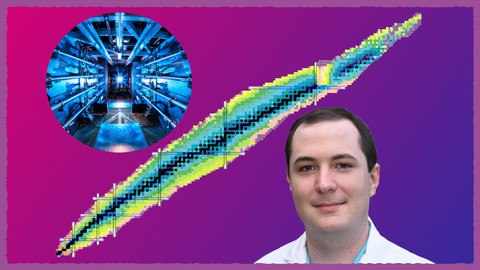
My name is William Roysdon Murray, and welcome to Nuclear Engineering 101!
There’s not many online resources available online for getting started with Nuclear Engineering, so I made my own! I first learned about nuclear fission in my high school Chemistry class, and I had hundreds of questions for my teacher after that lesson – Why does both splitting an atom and fusing two atoms both produce energy? Can you make infinite energy from splitting and fusing atoms over and over again? Why are we not using more nuclear power to fight climate change when it makes so much energy without carbon dioxide? How do we have so many nuclear power plants but none of them use fusion technology?
Well, I went to NC State University for about 6 years to study Nuclear Engineering and get my questions answered, and it put me about $86,000 in student debt by the time I was done. Not everyone has the time or the money for that! If you’re interested in Nuclear Engineering but its not taught at your school, or you don’t want to go through the hassle of enrolling in a university again, this course is for you! I’ve developed this course based off my first year of nuclear courses at NC State, even using the same textbook – Fundamentals of Nuclear Engineering by Shultis and Faw. My lectures will guide you through the physics concepts covered in each chapter, and the textbook will serve as your technical guide for modelling the physics with mathematics. I’ll even walk you through number crunching the homework problems in Python to show you how to use the textbook to better understand nuclear science!
My hope for this course is that you will discover the magic behind nuclear technology and find a specialty within nuclear that you will want to continue studying – I’ll tell you where to go next at the the end of the course based on what you like too!
Radiation Physics: Classical physics from Newton won’t be enough for us to understand how nuclear technology works! We will cover the advances in physics made by the likes of Meitner, Schrodinger, Einstein, and others in the early 20th century in preparation for our deep dive into nuclear reactors and medicine.
This course covers:
- Fundamentals of atomic structure, modern physics, and Einstein’s Special Theory of Relativity
- The various types of particle and electromagnetic radiation, and how radioactive decay processes can be modeled using differential equations
- Binary nuclear reactions between bombarding radiation and target nuclei – producing new isotopes and radiation in the process
- How radiation interacts with matter – calculating nuclear reaction rates in materials that and the basics of radiation shielding
Nuclear Fission: Nuclear power plants are one of the largest sources of carbon-free electricity in the world. Understanding the nuclear fission process is absolutely necessary to designing the next generation of nuclear power plants to fight climate change. This course covers:
- Calculating the energy released from nuclear fission and chain reactions
- The anatomy of a nuclear reactor and how its components control the chain reaction
- Differences between Traditional and Advanced nuclear reactors, including Small Modular Reactors and Liquid-Metal Reactors
- Basics of the nuclear fuel cycle – how we mine uranium, enrich it, use it in power plants, and dispose of it as nuclear waste. Nuclear waste reprocessing and recycling is also discussed!
Nuclear Fusion: Fusion technology aims to harness the power of the stars with the greatest advancements in science and engineering, without the harmful waste that comes with nuclear fission technology. Dozens of companies are pursuing the fusion dream and aiming to be the first to connect a fusion reactor to the electricity grid. This course covers:
- Comparing the energy released and waste produced by fusion power compared to fission power
- Basics of Plasma Science and Engineering that are necessary for advanced studies in fusion energy
- Types of nuclear fusion reactors – Gravitational Confinement (Stars & the Sun), Magnetic Confinement (Tokamaks and Stellarators), and Inertial Confinement Fusion (High-Energy Lasers)
Nuclear Medicine: Nuclear technology has brought incredible advancements in diagnostic and therapeutic medicine over the last century. Over 40 million nuclear medicine procedures are performed each year, with demand constantly increasing! This course covers:
- How medical radioisotopes are produced in reactors and particle accelerators
- How these isotopes can be used to perform diagnostic imaging and destroy cancer cells
- How radiation can be applied externally without invasive surgery to irradiate tumors
- How nuclear diagnostic and therapeutic devices are built and the principles of their operation
HOMEPAGE – https://www.udemy.com/course/ne101-fundamentals-of-nuclear-science-and-engineering/
Free Download Link-
Note: Comment below if you find the download link dead.


0 Comments