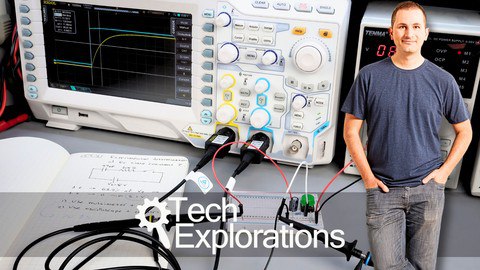
Master the fundamentals of electronics with hands-on projects and practical knowledge for beginners.
Are you ready to dive into the fascinating world of electronics? Whether you’re a hobbyist looking to build your first circuit, a student seeking a deeper understanding of how electronics work, or a professional expanding your skillset, this course is your gateway to mastering the essentials of electronics.
In this beginner-friendly course, you’ll learn the fundamental concepts of electricity, circuits, and components through a series of engaging, hands-on projects. From understanding the basics of Ohm’s Law to building circuits on a breadboard, you’ll gain the confidence to design, assemble, and troubleshoot your own electronic creations.
With easy-to-follow lessons, practical examples, and plenty of real-world applications, this course will help you unlock the secrets of the technology that powers our modern world. Start your journey into electronics today and bring your ideas to life!
Who is this course for?
This introductory electronics course is designed for anyone who wants to build a solid foundation in electronics, whether you’re a complete beginner or have some prior experience and wish to formalize your understanding.
- Hobbyists and DIY Enthusiasts: If you’re interested in creating your own electronic projects, tinkering with circuits, or working with microcontrollers like Arduino or Raspberry Pi, this course will give you the essential knowledge and skills to succeed. You’ll learn how to work with resistors, capacitors, transistors, and more, as well as how to measure and troubleshoot circuits effectively.
- Engineering and Science Students: Whether you’re in high school, college, or university and need a strong understanding of electronics for your coursework, this course provides a comprehensive introduction to key concepts like Ohm’s Law, Kirchhoff’s Laws, and circuit theorems. It’s ideal for those in fields like electrical engineering, computer science, or physics.
- STEM Educators: Teachers and educators looking to enhance their classroom instruction with hands-on electronics activities will find this course a useful resource. It introduces fundamental principles and practical applications that can easily be incorporated into lesson plans and experiments.
- Professionals Looking to Broaden Skills: If you work in a technical field (e.g., IT, telecommunications, software development) and want to deepen your understanding of hardware and electronic circuits, this course is a perfect way to extend your skill set.
- Makers and Inventors: For individuals passionate about inventing and prototyping, this course will help demystify the components and techniques behind functional electronic designs. You’ll be able to apply what you learn directly to building your own innovations.
- Complete Beginners: No prior knowledge of electronics is required. This course starts with the basics—covering electricity, circuits, and key components—and progresses to more advanced topics like circuit analysis, breadboarding, and signal measurement.
This course is for anyone looking to gain practical, hands-on experience with electronics, whether your goal is personal projects, academic success, or professional development.
What are the objectives of the course?
This course is designed to provide a comprehensive introduction to electronics, focusing on building practical skills and understanding key concepts. By the end of the course, you will be able to:
- Understand the Basics of Electric Circuits:
- Grasp foundational concepts such as electricity, electronic circuits, and signals.
- Differentiate between Direct Current (DC) and Alternating Current (AC) circuits.
- Identify and understand the functions of essential electronic components like resistors, capacitors, diodes, transistors, and integrated circuits.
- Apply Ohm’s Law and Watt’s Law:
- Calculate voltage, current, and resistance in various types of circuits.
- Use Watt’s Law to perform power calculations in single-resistor and multi-resistor circuits.
- Understand and apply voltage and current divider principles.
- Master Breadboarding and Circuit Assembly:
- Learn how to correctly use a breadboard to prototype circuits.
- Understand how to handle and place electronic components in circuits.
- Troubleshoot and diagnose issues in breadboarded circuits effectively.
- Use a Multimeter for Measurements and Testing:
- Measure voltage, current, resistance, and test continuity in circuits.
- Gain proficiency in using an auto-ranging multimeter.
- Follow safety procedures when using a multimeter.
- Understand Circuit Theorems and Analysis:
- Apply Kirchhoff’s Laws (KVL and KCL) to analyze complex circuits.
- Learn and implement Thévenin’s Theorem, Norton’s Theorem, Superposition Theorem, and Maximum Power Transfer Theorem in both theory and practice.
- Perform mesh and nodal analysis for calculating voltages and currents in circuits.
- Work with Capacitors, Inductors, and RC/RL Circuits:
- Understand the behavior of capacitors and inductors in AC and DC circuits.
- Calculate and measure capacitance and inductance in series and parallel configurations.
- Explore the time constant in RC circuits and its practical implications in charge-discharge experiments.
- Analyze and Measure Signals:
- Get introduced to signal analysis and measurement techniques using oscilloscopes.
- Understand AC signals, including sinusoidal, square, and triangular waves.
- Learn how to use signal generators and oscilloscopes for analyzing waveforms and measuring signal parameters.
- Simulate and Experiment with Circuits:
- Use circuit simulators to model and test circuits before building them.
- Perform hands-on experiments with resistors, capacitors, and inductors to observe their real-world behavior in circuits.
- Test theoretical concepts such as voltage division, filtering, and reactance using simulators and breadboards.
HOMEPAGE – https://www.udemy.com/course/intro-to-electronics/
Free Download Links-
Note: Comment below if you find the download links dead.


0 Comments